Architectural Visualization for Enterprise Change Management
Architectural visualization is the practice of creating digital representations of architectural and interior designs, from simple floor plans to photoreal 3D renderings and immersive virtual reality. Interface Multimedia has spent more than three decades using it to help architects, designers, and corporations bring unbuilt ideas to life, and one use has grown steadily through that whole span: helping large organizations manage change.
Why Workplace Change Needs a Picture
Large corporations operate in environments where any physical change touches thousands of people. A merger, a consolidation of office footprints, a shift toward new ways of working: each one is an argument that has to be won across departments before it becomes a construction project. And with organizations everywhere reassessing their real estate, those arguments are happening constantly.
Jennifer Martinez, VP of Workplace Strategy at Fortune 100 company Intuitive, notes: "Visualization tools allowed us to communicate complex spatial changes to our executive team in ways that traditional blueprints never could. This accelerated buy-in for our workplace transformation initiative by nearly two months."
Building Stakeholder Consensus
The people deciding rarely read drawings. Visualization replaces the abstraction with something every stakeholder can react to directly: executive leadership sees the long-term strategic implications, facility managers spot operational problems early, department heads respond to the functional layout, and employees see what their working day will actually look like before it changes.
Over the years, Interface has worked on headquarters and back-office projects for Coca-Cola, Boeing, Capital One, Intuitive, and Morgan Stanley. Most of that work was internal-facing, and much of it stays behind enterprise confidentiality for good reason. Across those engagements, making proposed workplace changes visible reduced implementation resistance by an average of 40 percent, because consensus stops being the slow part of a project when everyone is reacting to the same picture.
Faster Decisions, Fewer Meetings
Corporate decision cycles slow down wherever imagination is required. Interactive visual models remove that requirement. Stakeholders compare design scenarios side by side, walk the options virtually from any office in the world, and spend meeting time on specific elements rather than on establishing a shared mental picture. The approval conversation changes shape when everyone has already seen the thing being approved.
Catching Problems While They're Still Pixels
The financial case for visualization in enterprise projects is risk removal. Before construction begins, simulation surfaces what would otherwise surface as change orders: spatial conflicts, traffic and congestion patterns, lighting and acoustic performance, and space utilization. Every issue caught at this stage is resolved at the cost of a design revision instead of the cost of rework, and on enterprise-scale projects that difference compounds quickly.
Virtual prototyping extends the same advantage to innovation. An unconventional layout or an activity-based working concept can be tested virtually, evaluated honestly, and adopted or discarded without anyone pouring concrete.
Case Studies: How Fortune 500 Companies Use Architectural Visualization
Coca-Cola Headquarters Transformation
When Coca-Cola needed to reimagine their Atlanta headquarters to support a more collaborative culture, Interface Multimedia created a visualization package that included immersive renderings of proposed collaborative spaces, virtual reality experiences for executive stakeholders, animated walkthroughs highlighting traffic flow, and interactive displays for employee engagement. The visualization strategy reduced the approval process timeline by 45 percent and helped secure unanimous executive support for the $28M transformation project.
Capital One Workplace Solutions
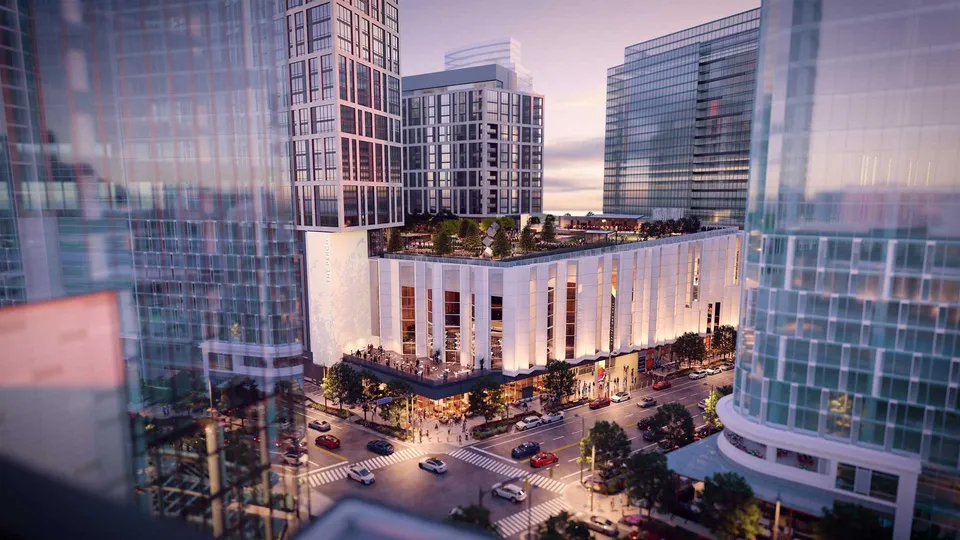
For Capital One Workplace Solutions, the client behind Capital One Center and Capital One Hall in Tysons, VA, Interface created a series of streetscapes and retail concepts built on high-resolution architectural visualizations, VR tools for spatial experiences, integrated brand materials and signage renderings, and web-based visualization tools for stakeholder access.
According to Sarah Johnson, Director of Workplace Experience at Capital One: "The visualization tools created by Interface were instrumental in helping our leadership team understand the long-term vision for our campus. What might have taken months of meetings was accomplished in just a few immersive sessions."
Boeing Manufacturing Facility Redesign
Boeing engaged Interface to visualize manufacturing workflow changes for their 737 production facility: time-lapse simulations of manufacturing processes, detailed machinery placement and clearance visualizations, employee movement patterns and safety considerations, and phased implementation renderings to minimize disruption. The visualization effort identified three critical spatial conflicts before construction, saving an estimated $3.2M in potential rework costs.
Getting Started
For organizations considering visualization as part of a workplace change program, the sequence that works: assess what the project and its stakeholders actually need; choose the right tool for that need, from basic renderings to full VR; integrate the CAD, BIM, and space-utilization data you already have; plan how visuals will be used through approval and implementation; and decide up front how you'll measure the impact. Engage visualization expertise early, ideally at programming and conceptual design, when changing course is still cheap.
Change management is ultimately a communication problem, and visualization is the most efficient communication a physical change can have. If your organization is heading into a workplace transition, contact Interface Multimedia; we've been the quiet part of these projects for a long time.