

ConsentLine
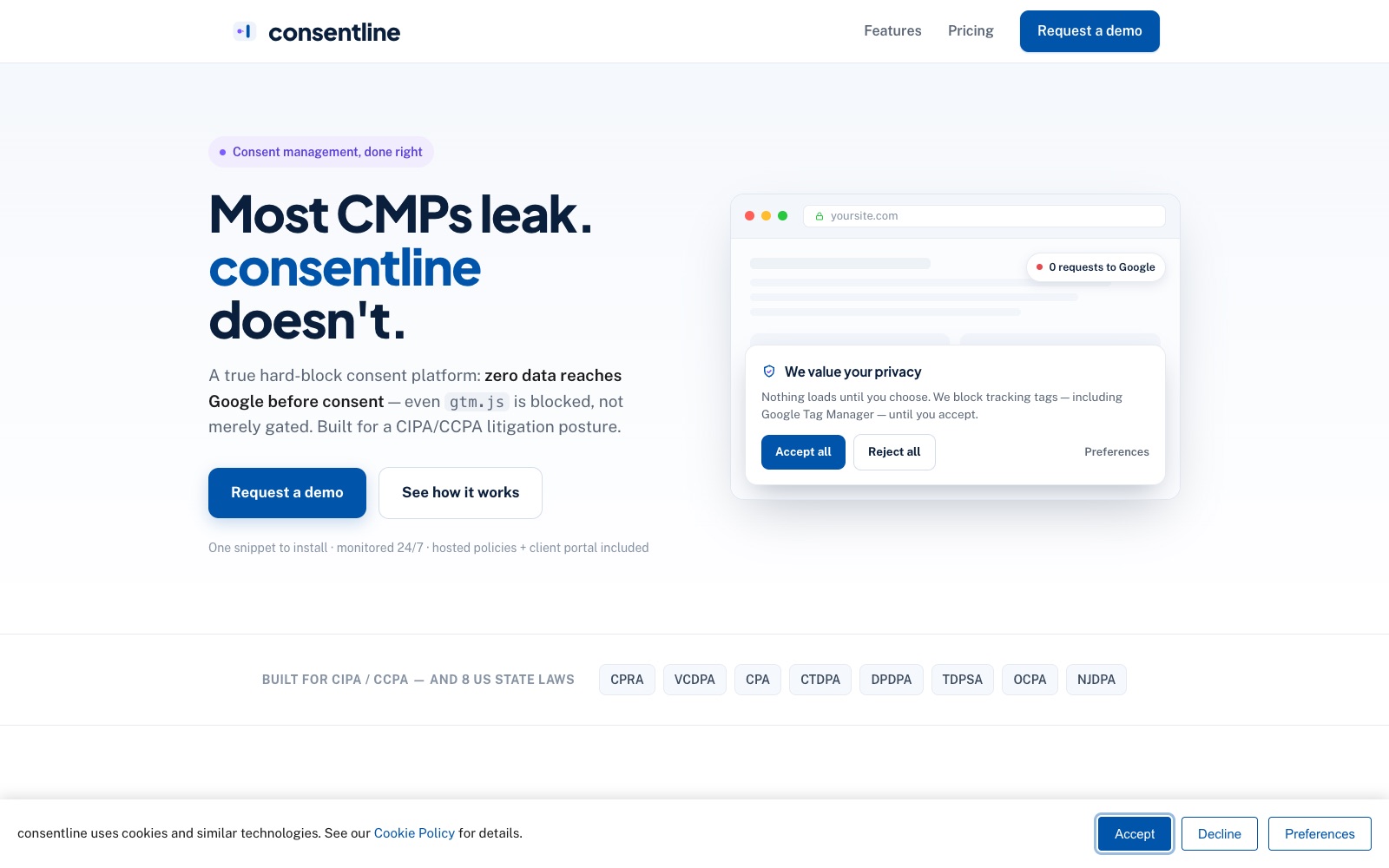
A consent management platform engineered by Interface that blocks GTM and analytics scripts from entering the document until a visitor grants permission. Zero requests to Google before consent—verified with network captures on every deployed site.
Visit consentline.com open_in_newMost consent management platforms rely on Google Consent Mode, which allows tags to fire "cookieless" pings before a visitor has agreed to anything. ConsentLine takes a different approach: it gates the document itself. No analytics or marketing script enters the page until consent is granted. Interface built the platform after observing real cases of analytics firing before consent under conventional CMP setups, including on our own site. That observation drove the architecture: block by default, verify by network capture, and treat compliance as an operated service rather than a one-time install. ConsentLine runs in production across Interface-operated client sites and on ifmm.com and consentline.com: the platform runs its own CMP.
The hard-block difference
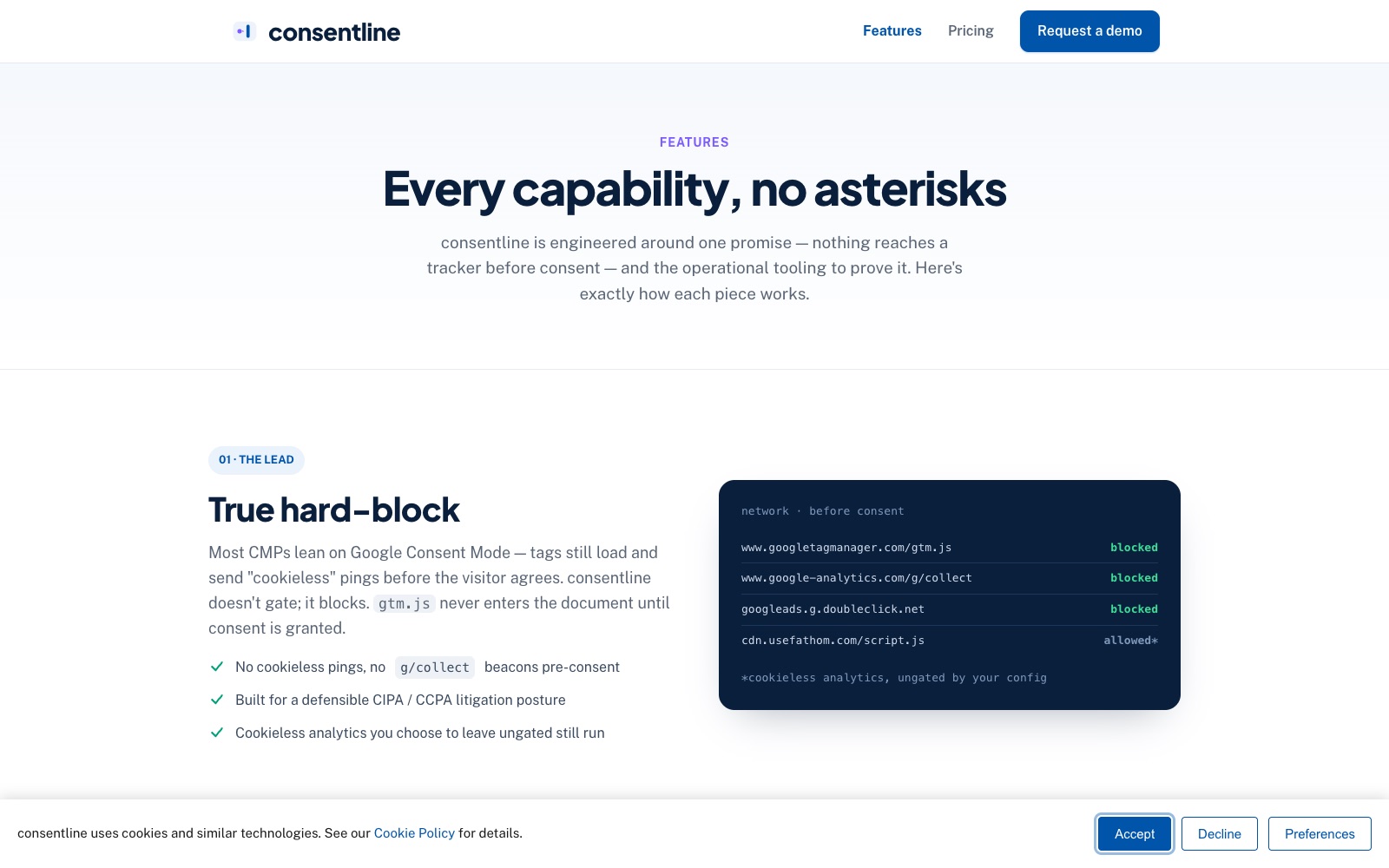
Most CMPs operate by configuration: they instruct tags to suppress certain data when consent is absent. ConsentLine operates by exclusion: GTM and analytics scripts do not enter the document until the visitor grants permission. There is no configuration to misconfigure, no cookieless ping that slips through. Every deployed site is verified by network capture: the panel shows zero requests to Google before consent is given.
Jurisdiction-aware compliance and Global Privacy Control
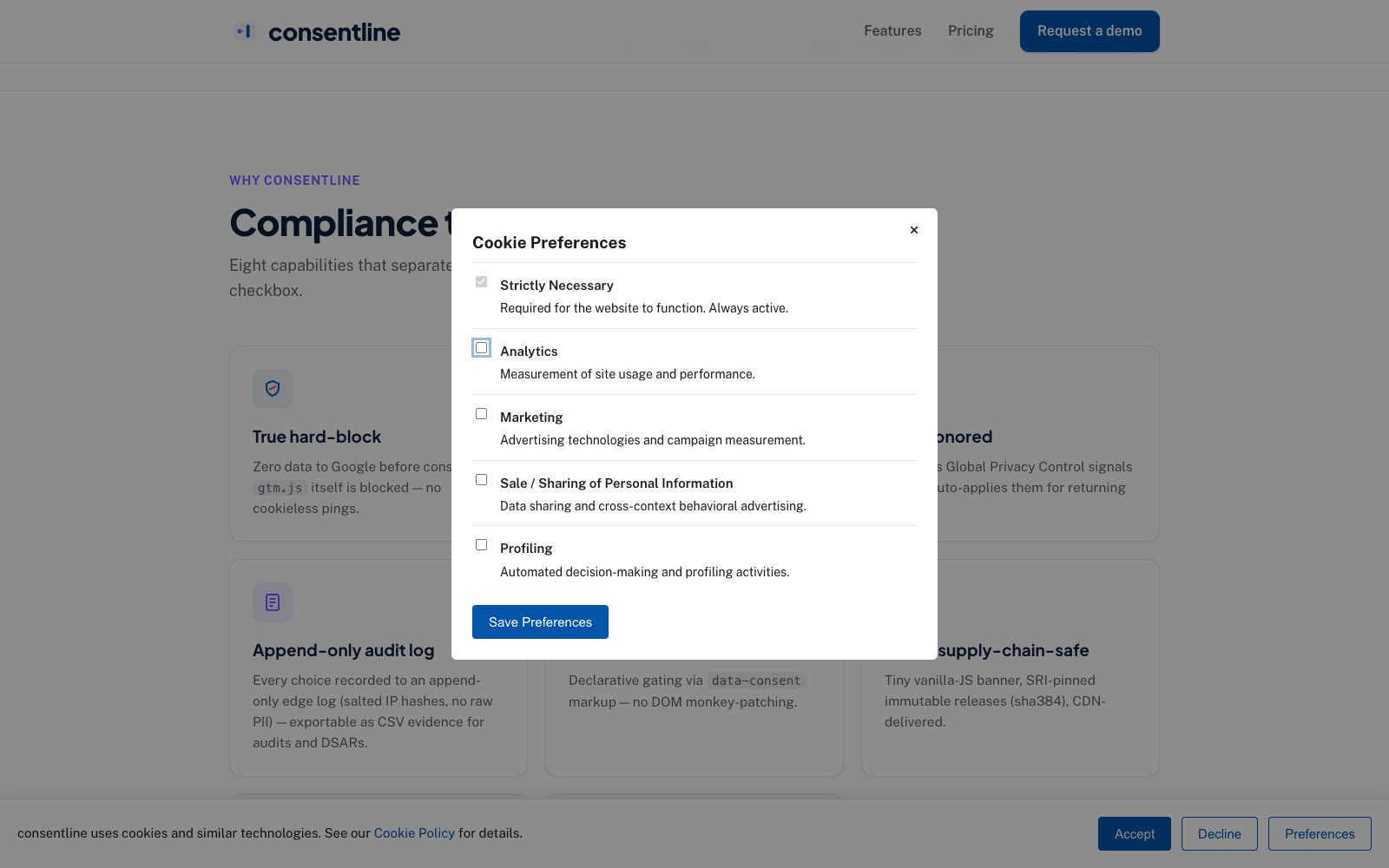
ConsentLine geo-detects each visitor at the edge and applies the correct ruleset across eight US state privacy laws (CPRA, VCDPA, CPA, CTDPA, DPDPA, TDPSA, OCPA, and NJDPA) plus a US baseline. When location cannot be determined, the platform fails closed to the most conservative posture in the ruleset. Global Privacy Control browser signals are honored on first visit and re-applied for returning visitors.
Evidence log and 24/7 monitoring
Every consent choice is recorded to an append-only log with salted IP hashes; no raw PII is stored. The log is exportable as CSV for audits and data-subject requests, and archived daily with integrity verification. An independent monitor checks every deployed site around the clock for configuration drift and uptime, alerting the team on first failure. Compliance is treated as an operated service: the platform does not assume a correct install stays correct.
Hosted policies, portal, and real-estate document options
Privacy policy, terms, and cookie policy are authored from original counsel-reviewed templates, written from scratch rather than derived from any vendor's documents, and hosted centrally. A client portal allows edits, but every change is human-reviewed before it goes live and recorded in permanent revision history. Embeds are paste-once: when a policy updates centrally, every embed on every site updates with it. For real estate clients, optional document sections cover fair housing, accessibility statements, DMCA, and property-marketing disclosures.
US state privacy laws carry real litigation risk, and most CMPs quietly leak: tags fire before consent in ways the configuration never flags. Interface built ConsentLine after confirming this pattern in production on our own properties. The platform blocks by default, monitors continuously, and keeps its compliance evidence in an auditable log. That is the same operational discipline Interface applies to infrastructure: continuous, monitored, and accountable long after launch.
Selected work
Capitol Hill History
Preserving the oral history of Capitol Hill residents.
Goose Creek Village
Lifestyle Center Branding
R&R Contracting
Your Trusted Minority Workforce Partner
Monday Properties
Monday invests in new online digital site.Where it earns its keep
- +Commercial real estate marketing sites
- +Multifamily and leasing websites
- +CIPA/CCPA litigation-posture hardening
- +Termly/OneTrust replacement
- +Ongoing compliance monitoring
About ConsentLine
How is ConsentLine different from a typical consent management platform?
expand_more
What visitor data does ConsentLine store?
expand_more
Does it work with Google Tag Manager and GA4?
expand_more
Can Interface deploy ConsentLine for our site?
expand_more
What happens if a visitor's location cannot be determined?
expand_more
Other Innovation Lab subjects
 Innovation Labarrow_forward
Real-Time Virtual Reality
Cinematic gaming engines—Unity and Unreal—rebuilt as architectural design tools. Real-time navigation, real-time material changes, headset-ready immersion before a single trade mobilizes.
 Innovation Labarrow_forward
4D Construction
A construction schedule rendered in the fourth dimension—time. Bar-chart efficiencies and conflicts surface as a 3D animation before crews mobilize.
 Innovation Labarrow_forward
360° Video & Immersive VR
Complete immersive experiences, built entirely in-house—from 8K aerial capture to a custom streaming platform. We fly, shoot, design, and engineer the whole pipeline, so nothing is handed off to a stock viewer.
 Innovation Labarrow_forward
Intelligent Digital Asset Management
A digital asset platform that reads, watches, and listens to everything in the library—so thirty years of produced work is one search away. Built entirely in-house, with every AI model running on our own hardware.
- Innovation Labarrow_forward
Envoy
An AI-assisted marketing platform for real estate, architecture, engineering and construction firms: marketing teams use it to build their website and manage its content in real time.