
Every few months someone at one of our clients' offices asks us whether they should start a podcast. Sometimes it's a principal who heard a good one on the drive back from a site visit, and sometimes it's a new marketing coordinator with a notebook full of ideas. It's a fair question and very hard to answer quickly. You really need to understand the client's marketing strengths and ultimately determine how hard that would be with their current skill set and what the marketing cost would be from an hourly standpoint. Most firms have never laid their options side by side to find out.
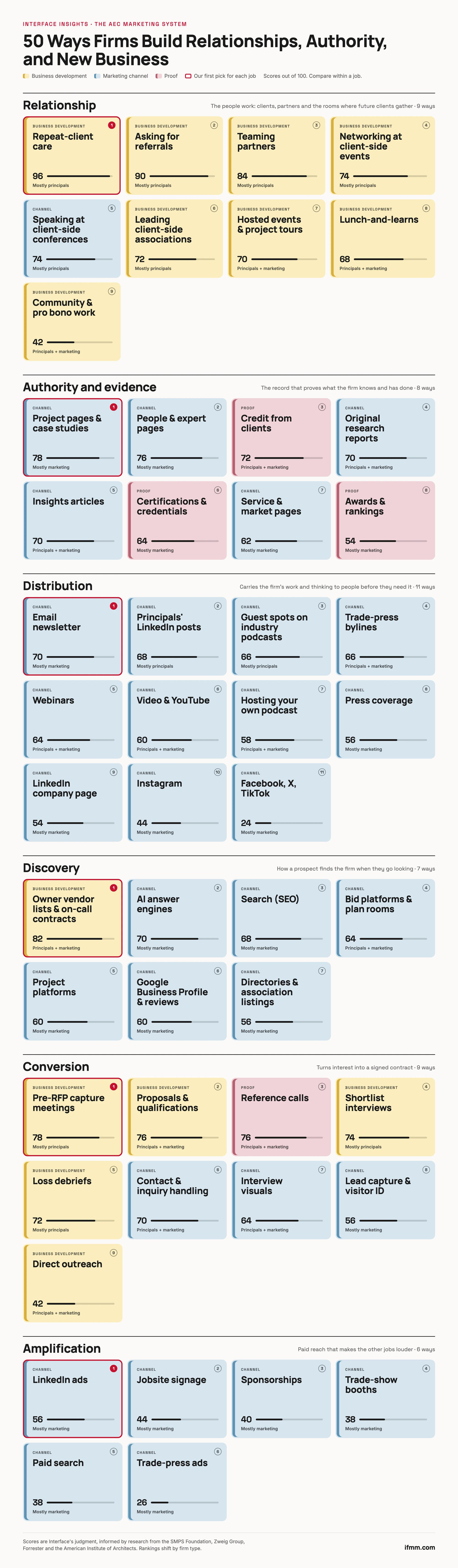
So we did. Below are 50 ways we've seen AEC firms market themselves over the years, sorted by the role each one plays and scored only against the others playing that same role. The scores are our judgment, drawn from the marketing work we do for architecture, engineering and construction clients and checked against the published research on how these firms win work. If the research is inconclusive for any of these claims, we'll tell you that too.
Work is won by a chain
Here's one path a win can take. A principal posts on LinkedIn about a finished project. A facilities director clicks through to the insights article behind it, and from there to the project page and the principal's bio. Then nothing happens for six months, until the two of them meet at a conference. A few weeks later an RFP arrives. The selection committee does a search, and the AI results recommend them as a candidate. The principal walks into the interview as a known commodity and begins the presentation from a position of strength.
Which step won the work? Every one of them had a hand in it. Each played a different role and mattered for what it handed to the next. Judged on its own, the LinkedIn post won nothing, yet everything that followed started there. Without any one step, the chain might have broken before the interview. That's why we don't rank all 50 against each other. A LinkedIn post and a shortlist interview are playing different roles, and putting them on one scale only rewards whatever sits closest to the signature.
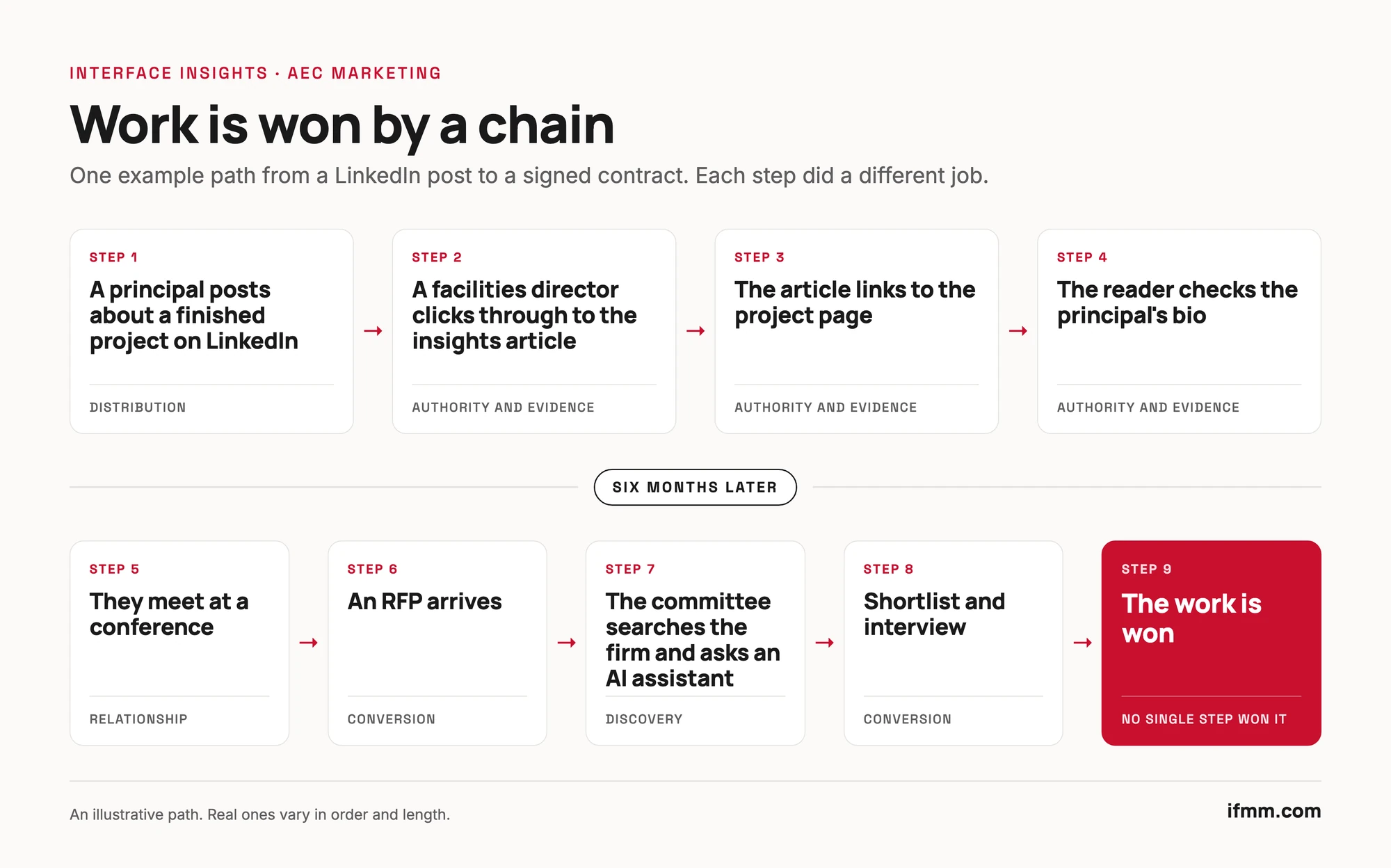
Which step won the work? Every one of them had a hand in it.
The 50 fall into six roles:
- Relationship is the people work: clients, partners and the rooms where future clients gather (9 ways).
- Authority and evidence is the record that proves what the firm knows and has done (8).
- Distribution carries the firm's work and thinking to people, mostly before they need it (11).
- Discovery is how a prospect finds the firm when they go looking (7).
- Conversion turns interest into a signed contract (9).
- Amplification is paid reach that makes the other roles louder (6).
Each item also carries a type, which the ranking shows in color. Thirty-two of the 50 are marketing channels in the strict sense (blue), and fourteen are business development (yellow). The last four are proof that someone else has to grant, like an award or a client's reference (rose).
Build a system, not a set of channels
Most AEC marketing teams run their channels one at a time. There's a LinkedIn calendar, an award deadline and a newsletter that goes out whenever someone finds time to write it. Each one starts from a blank page. The firm treats each piece of marketing communication as a "one-off" and not as a holistic ecosystem working together.
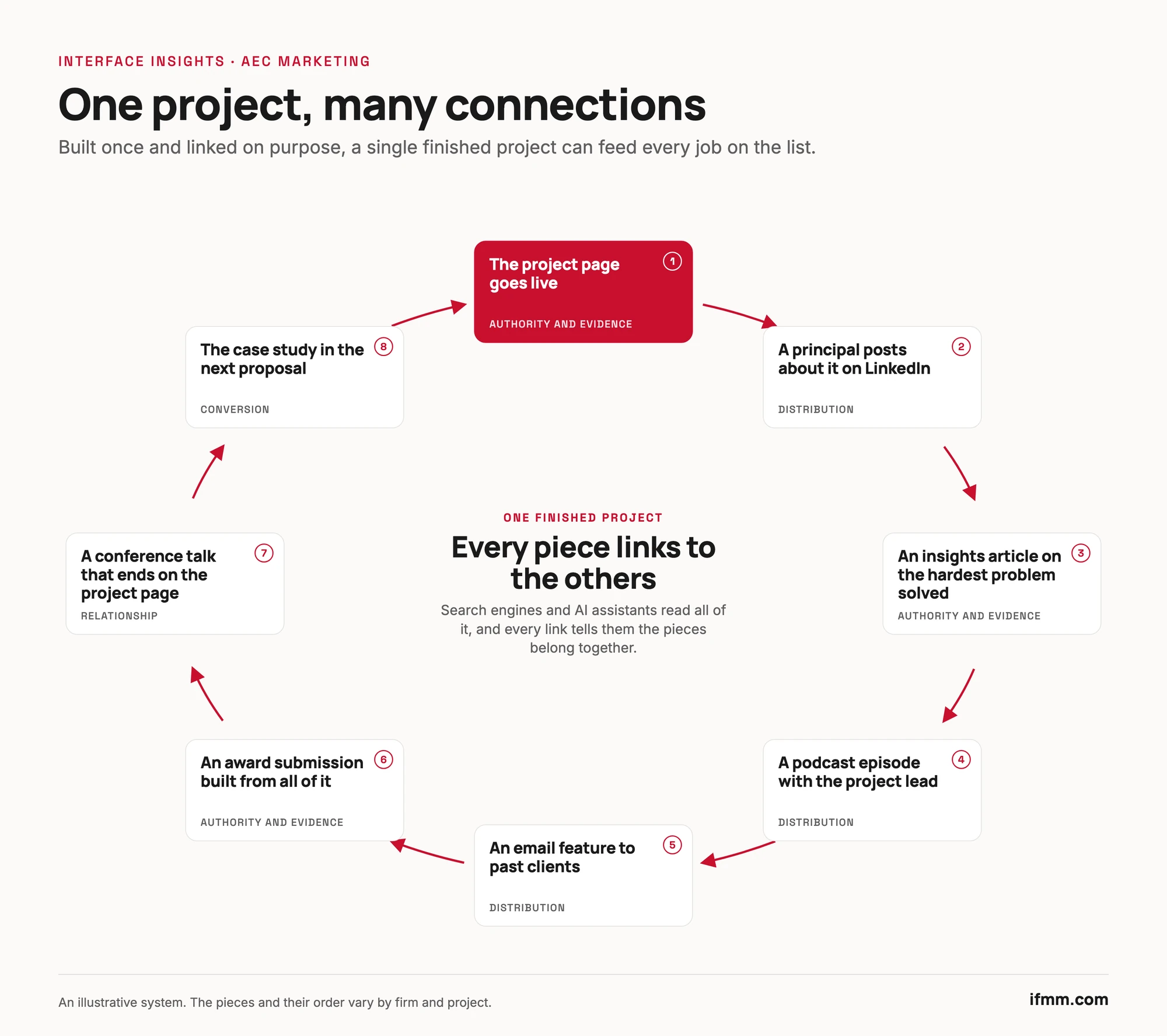
Consider a more holistic approach when a project has been completed and is ready for public distribution. The project page goes up first, with a short LinkedIn post from one of the principals' accounts. Then you follow shortly after with an insights article highlighting the most demanding and technically challenging solution they solved. If they have a podcast channel already running, they lead with an entire episode about the project, clarifying how they not only solved the technical challenge but also saved the company time by using their in-house teams. Then a quick email blast to a targeted set of past clients to try to re-engage them with the launch of this new project. The award submission borrows from all of it, and the next proposal reuses the case study. When the principal speaks about the project at a conference, the last slide is the project page. In the end, each piece of marketing communication is part of a holistic system that is now a connected knowledge map for this firm and enables AI search engines to piece everything together and build the whole picture for the company.
More connections give a prospect more ways in and more reasons to believe what the firm says about itself. This is true for the AI search engines as well. Without them each piece has to work alone. A post with nowhere to send people is a dead end, and a project page that nothing links to is hard for people and search engines alike to find.
Interface continually builds the connections between these marketing touchpoints to strengthen the potential of these resonating moments. We design websites that have project pages that link to insights articles and awards as well as the people and partners that made it all possible.
A post with nowhere to send people is a dead end.
How we scored them
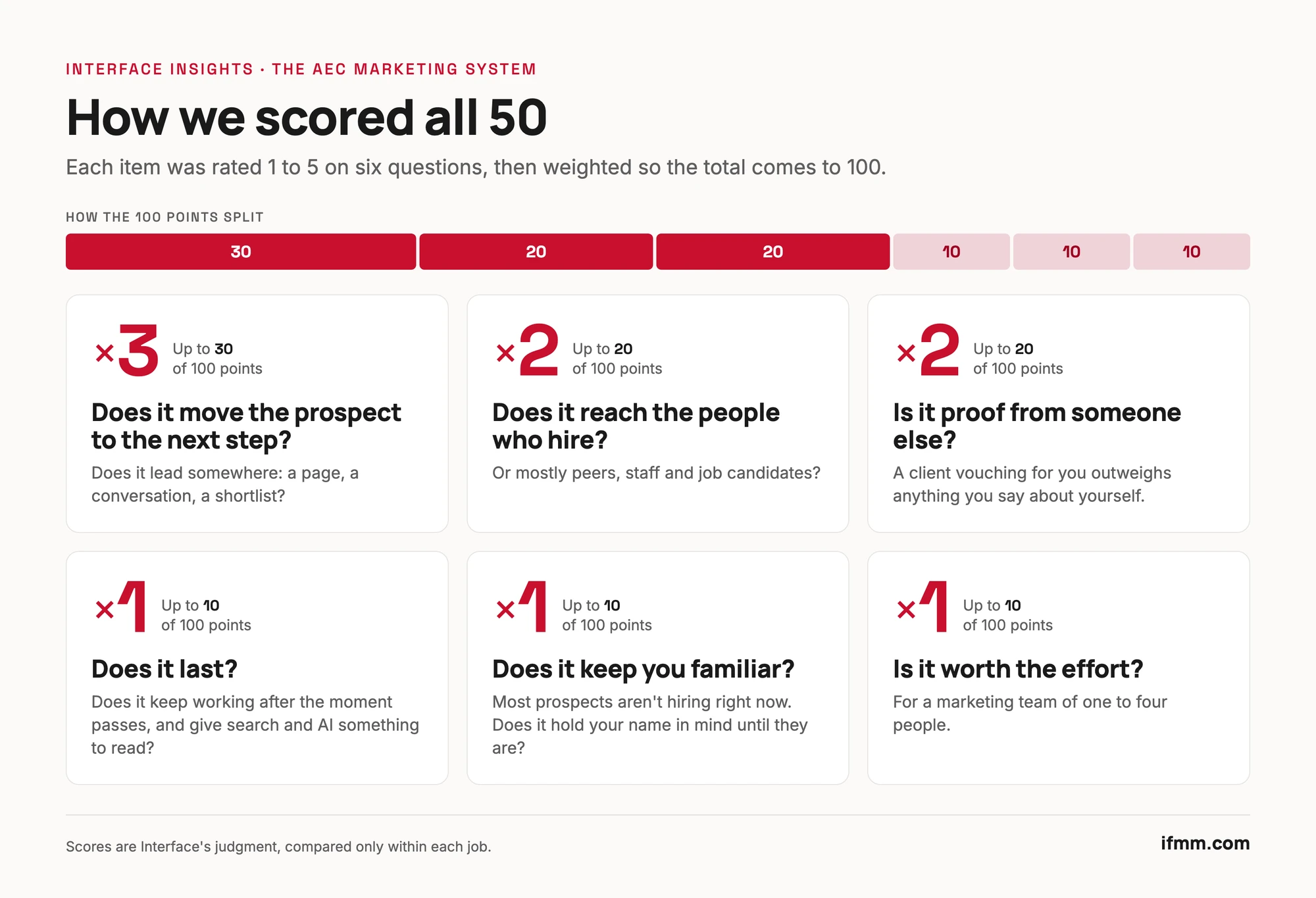
Within each role we rated every item from 1 to 5 on six questions and weighted the answers so the total comes to 100. The heaviest question is worth up to 30 points. It asks what the chain above depends on: whether the item moves the prospect to the next step, from a page to a conversation to a shortlist. The next two ask whether it reaches the people who hire and whether it carries proof from someone else, and each is worth up to 20. The last three are worth up to 10 each and cover how long the item lasts, how well it keeps you familiar and whether it's worth the effort. Compare scores only inside a role. The roles depend on each other, so a higher number in one role doesn't make an item a better investment than one in another.
What the market says works
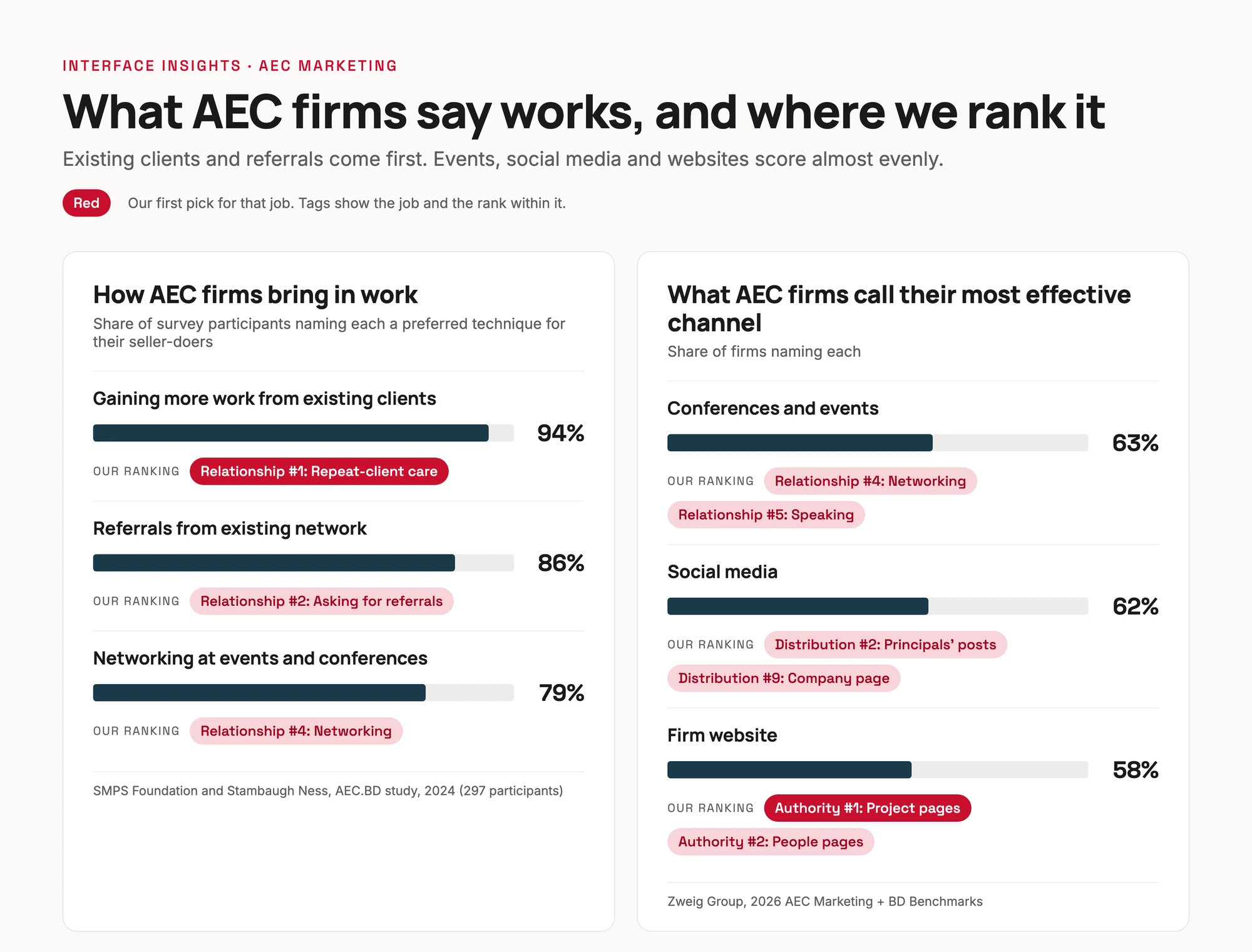
Ask AEC firms how they bring in work and the answers are old-fashioned. In a 2024 SMPS Foundation survey of 297 AEC professionals, 94 percent listed growing work with current clients among the techniques their seller-doers favor. Referrals from the wider network drew 86 percent, and networking drew 79. But ask which marketing channel works best and the answers flatten out. Zweig Group's 2026 benchmarks put events, social media and websites within five points of each other.
On the other side of the table, the people who hire firms lean harder on what they can find for themselves. Forrester's 2025 survey of business purchase decision-makers across industries found AI assistants and conversational search to be the most useful place to research a purchase. Respondents picked them twice as often as anything else, well ahead of vendors' own websites and salespeople.
Published research on the habits AEC firms trust mostly measures how widely they are used and liked. At least half of the SMPS respondents count delivering presentations among their seller-doers' techniques. The AIA's guidance to manufacturers notes that architects rank in-person lunch-and-learns high among the ways they like to learn about products. What's missing is clean data tying any of these habits to revenue or win rates. The research shows they shape the conditions under which work is won, but it rarely credits the win to any one of them.
Relationship: the people work
Repeat clients are the engine that keeps most of our clients' businesses running. This is where they have earned the trust and respect for their expertise. This role covers nine ways of doing that work: caring for current clients, asking for referrals, teaming partners, networking and speaking at client-side conferences, leadership in the associations where clients gather, hosted events and project tours, lunch-and-learns, and community work. Nearly all of it runs on principals' time; 89 percent of the firms in Zweig's benchmarks say bringing in work falls mainly to principals. Which items matter most depends on who hires the firm. For an MEP or structural engineer the most important client is often the architect or prime deciding whether to bring them onto the team, so teaming partners carry the weight. For a firm that sells to institutional owners, the weight shifts to the associations and conferences where those owners spend their time. Speaking engagements are important because of what happens after the talk. Research supports the fact that conferences and events are very effective channels, and a talk does its real work in the conversations afterward, when the people a principal met go and look at the project they heard about.
Authority and evidence: the record clients check
Social media posts, speaking engagements and client referrals all lead to someone reading about the firm, which is why keeping the website content up to date is critical. Testimonials from clients and deeper-dive case studies help to reinforce the firm's authority and evidence of true expertise. Certifications matter for more specific reasons around eligibility and meeting state and federal guidelines. Awards and rankings are also extremely important and provide the third-party credibility layer that moves selection committees and future prospects.
Distribution: getting in front of people
Distribution is how the firm's work and thinking reach their audience. There are many distribution channels: email, social media posts, websites, podcasts, trade-publication bylines, webinars, video, press coverage and more. Each distribution channel has a role in a marketing plan, and the best mix depends on the firm. A firm with a great email list can push content out on a regular basis for next to nothing. A principal with a large social media following could have a larger impact than the company website. Again, whichever channel is the right path, every marketing touchpoint leads back to the public website.
Discovery: found when they look
Discovery is how a prospect finds the firm when they go looking, and it only works if the rest of the system gave them something worth finding. The routes are few and specific: owner vendor lists and on-call contracts, AI answer engines, search, bid platforms and plan rooms, project platforms such as ArchDaily, a Google Business Profile with reviews, and the directories where procurement officers look firms up. Which ones matter depends on the prospect. Institutional and public owners start with the firms already on their list, so getting onto that list is a pursuit in its own right. General contractors find the trades for a bid on the bid platforms. Design firms get found on the project platforms, and contractors doing residential and local work get found through their Google profile and reviews. AI engines and search read the same pages the system builds: when Profound analyzed 11.84 billion AI citations, about 57 percent pointed to brands' own websites. Whatever the route, the prospect lands on the firm's own record.
Conversion: turning interest into a contract
Conversion is the work between a prospect's interest and a signed contract. This role runs from pre-RFP capture meetings through proposals and statements of qualifications, reference calls and site visits, shortlist interviews and the visuals brought into them, loss debriefs, and the plain mechanics of how an inquiry gets answered. The best conversion work starts before the RFP does. A firm that has already thought the project through with the owner is rarely a stranger when the proposals arrive. From there every step draws on what the other roles built: the case study in the proposal, the client who agreed to take the reference call, the project page the committee looked at before the interview. Two items cost almost nothing: a loss debrief, which tells you what the owner weighed, and an inquiry answered quickly by a real person, the least glamorous item in this role and the easiest fix on the list.
The best conversion work starts before the RFP does.
Amplification: making the other roles louder
Amplification is paid reach: LinkedIn campaigns behind a principal's thinking, jobsite signage, sponsorships, trade-show booths, paid search and display advertising. It is the easiest role to buy and the easiest to waste. Amplification can't fill any of the other roles. It can only make them louder, so its budget belongs behind pieces that already connect to the rest of the system. The right spend depends on the firm. Paid LinkedIn puts a principal's thinking in front of decision-makers who don't follow the firm. Jobsite signage and fence wraps earn their keep for contractors, and paid search pays for residential and local service contractors and almost no one else. A sponsorship is worth the access it buys, and a booth is worth less than simply being at the conference.
Amplification can't fill any of the other roles. It can only make them louder.
Your firm's ranking will differ
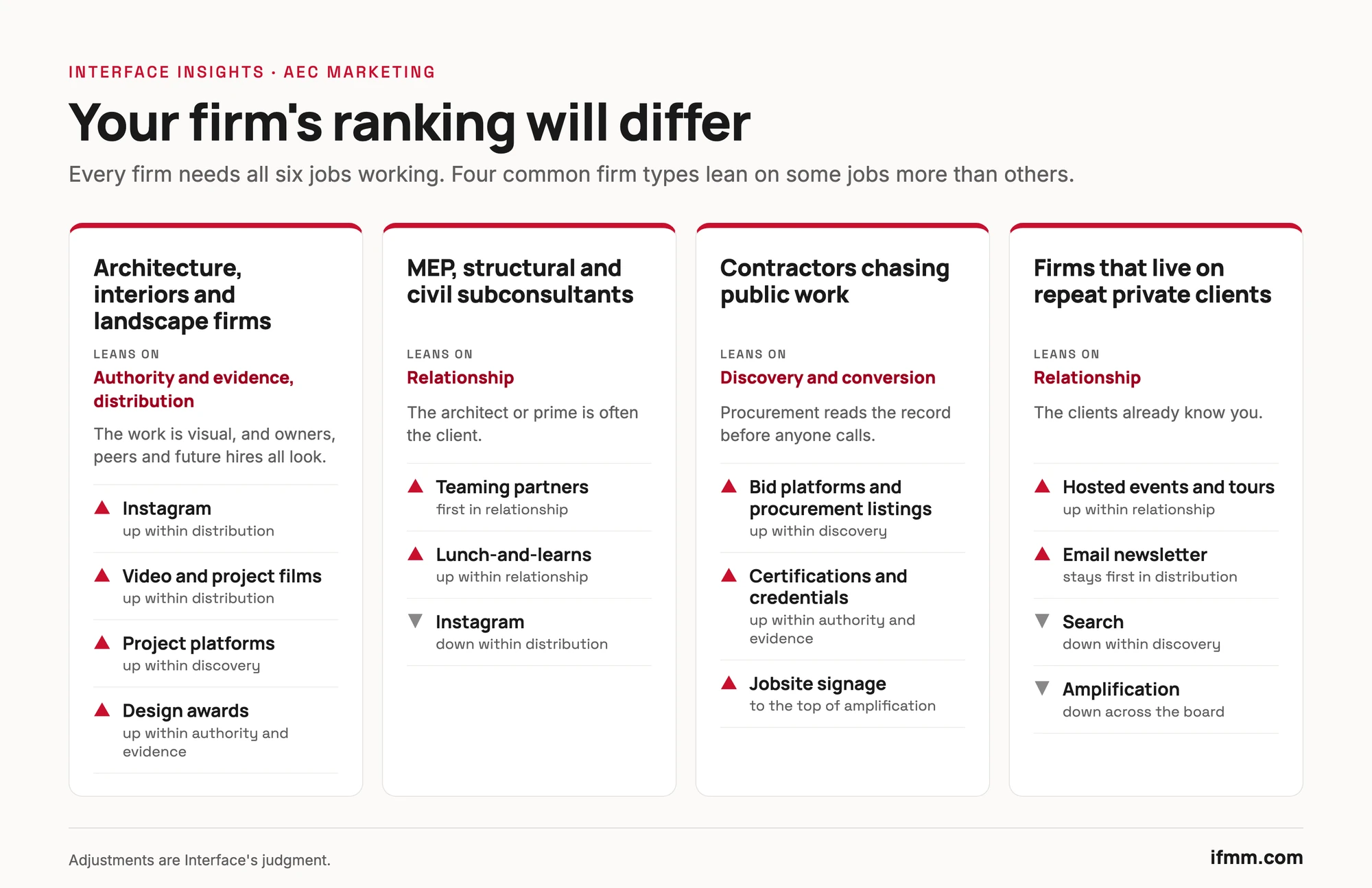
The scores describe a typical firm, and few firms are typical. Every firm needs all six roles working, but four common types lean on some roles more than others.
- Architecture, interiors and landscape firms lean on authority and distribution. The work is visual, and everyone from owners to peers to future hires looks at it. That moves Instagram, project films, project platforms like ArchDaily, design awards and design press up within their roles.
- MEP, structural and civil engineers working as subconsultants lean on relationship. Teaming partners move to the top of that role and lunch-and-learns climb, since the architect is often the client.
- Contractors chasing public work lean on discovery and conversion. Bid platforms and procurement listings climb within discovery, certifications climb within authority, and jobsite signage moves to the top of amplification.
- Firms that live on repeat private clients, such as developers and corporate real estate groups, lean on relationship and email more than on search or paid reach.
So, the podcast
Probably not yet. A podcast is a distribution play, and within that role a guest spot on a show your clients already listen to scores higher than hosting your own. So start there. Book a principal as a guest and publish the episode on your own site, with a write-up that links to the project and the people behind it. Then send it to past clients in the next newsletter. It costs an afternoon, and it leaves one more page for the next prospect who looks the firm up.
What to do with all 50
The point isn't to do all 50. The firms with the strongest marketing aren't the ones doing the most things on this list. They're the ones making the things they already do reinforce one another:
- A project becomes evidence.
- Evidence becomes a story.
- The story gets distributed.
- Distribution creates discovery.
- Discovery leads to relationships.
- When an opportunity arrives, all of it pushes toward the win.
Don't build 50 marketing channels. Build one communication system.
Sources
- Society for Marketing Professional Services (SMPS) Foundation and Stambaugh Ness, AEC.BD: Building Business Development Success in a Post-Pandemic World, 2024.
- Zweig Group, 2026 AEC Marketing + Business Development Benchmarks, September 2026.
- Forrester, B2B Buyers Make Zero-Click Buying Number One, January 2026, reporting Forrester's Buyers' Journey Survey, 2025.
- American Institute of Architects, Delivering Excellent Continuing Education for Architects: A Guide for Manufacturers, 2024.
- Profound, Where Do AI Citations Come From?, July 30, 2026.