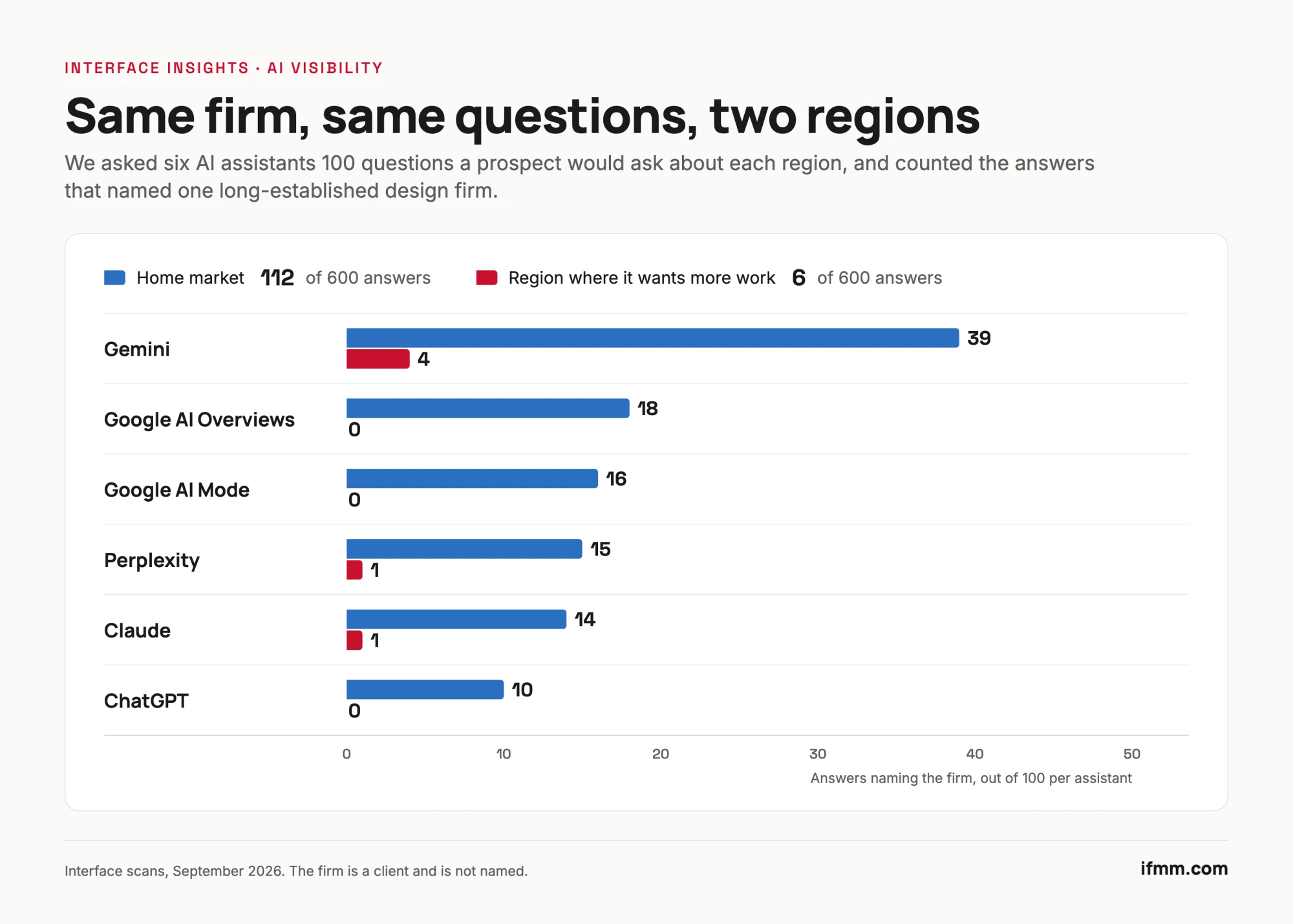
A long-established design firm we work with wants more work in a region outside its home market. We asked six AI assistants the same 100 questions a prospect would ask about that region. Across all six AI search engines, the firm appeared only six times. Then we asked the same 100 questions about its home market, where it has worked for decades, and the firm appeared over a hundred times.
These AI engines have no judgment of their own. It retrieves documents and reads the passages inside them, and when enough of those passages agree, their version becomes the answer. Together those documents make up the firm's paper trail: its own pages, plus whatever clients, trade publications and award programs have written about its work. This firm's trail runs decades deep at home and only a few projects deep in the region where it wants more work.
The paper trail is also where firms lose ground without knowing it. A Mid-Atlantic contractor we've worked with has held a state DBE/MBE certification for more than two decades, and it's still verified and current. But it sits in a state registry behind a CAPTCHA that blocks AI crawlers. So the strongest trust signal this firm owns is invisible to every AI engine. The fix isn't to publish more but to get that one fact restated somewhere a crawler can reach, such as a case study, a press mention or a directory listing.
It also matters who does the restating. Your own site makes you visible, but a claim repeated there is still only your word. Proof comes from someone independent who says the same thing and names you: a client's own case study, a trade write-up or an award you won rather than entered. Ahrefs found a similar pattern across roughly 75,000 brands: mentions of a brand across the web tracked with AI visibility far more closely than backlinks did, though the study's authors are careful to call it a correlation. The naming is easy to miss: we've seen award announcements credit the project and never name the design firm.
None of this replaces ordinary search visibility. Every engine we've looked at still needs a page to be crawled and indexed before it can cite that page at all. Ranking well gets your pages read, but what an engine says about your firm depends on the rest of the paper trail.
Most agencies chasing AI citation measure the wrong things. They track keywords, clicks and rankings because those are easy to count, but the real target is the trust and authority of the whole firm, built from its actual history rather than from a page score.
Building that kind of trust is hard for a consumer startup, because it has no track record yet. An AEC firm with decades of projects has the opposite problem: the record already exists, but much of it was never written down where an engine can read it. For a single service, the contractor with the CAPTCHA problem has 110 pieces of evidence in its own records, and we can find only seven of them on the public web. Finding those gaps and filling them in is what we call Mining the Gaps.
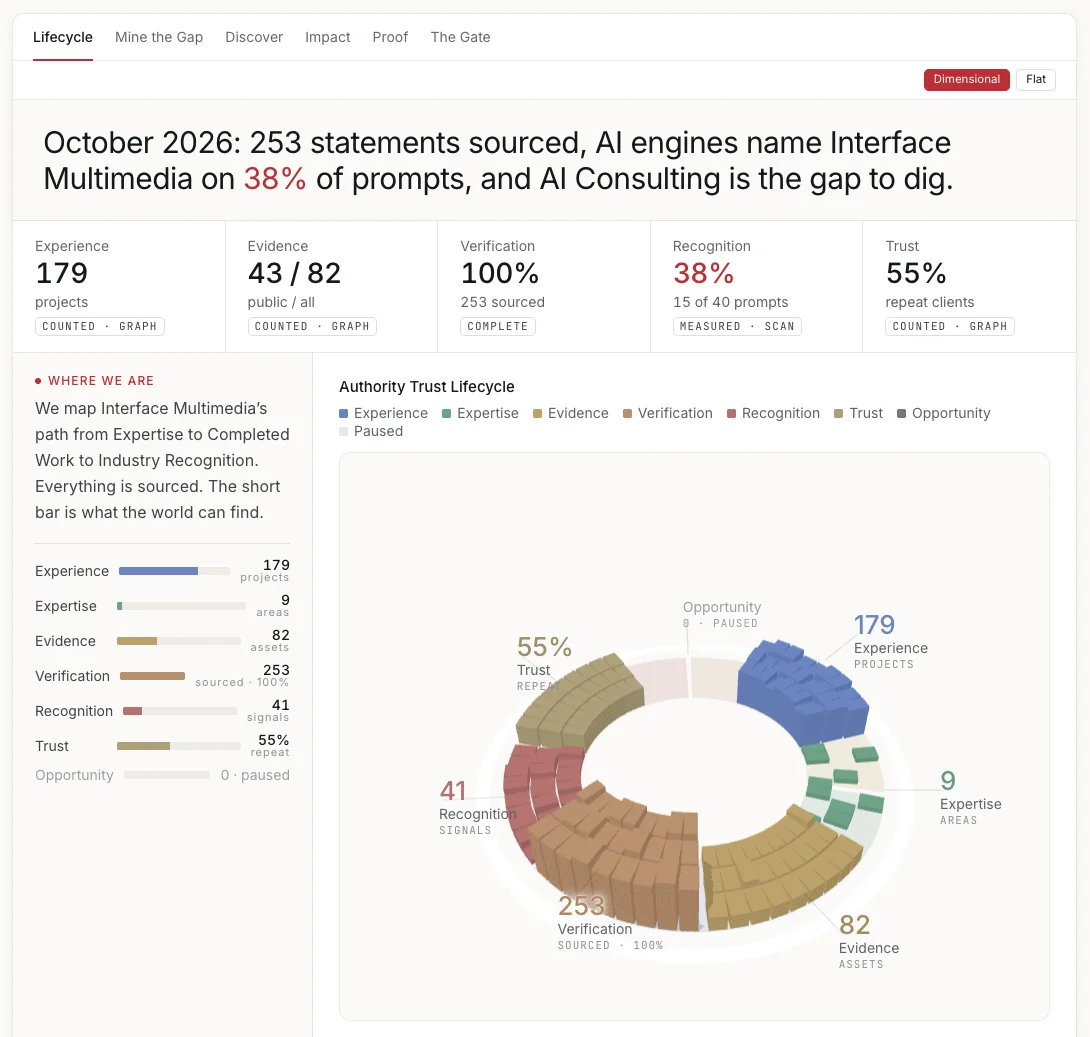
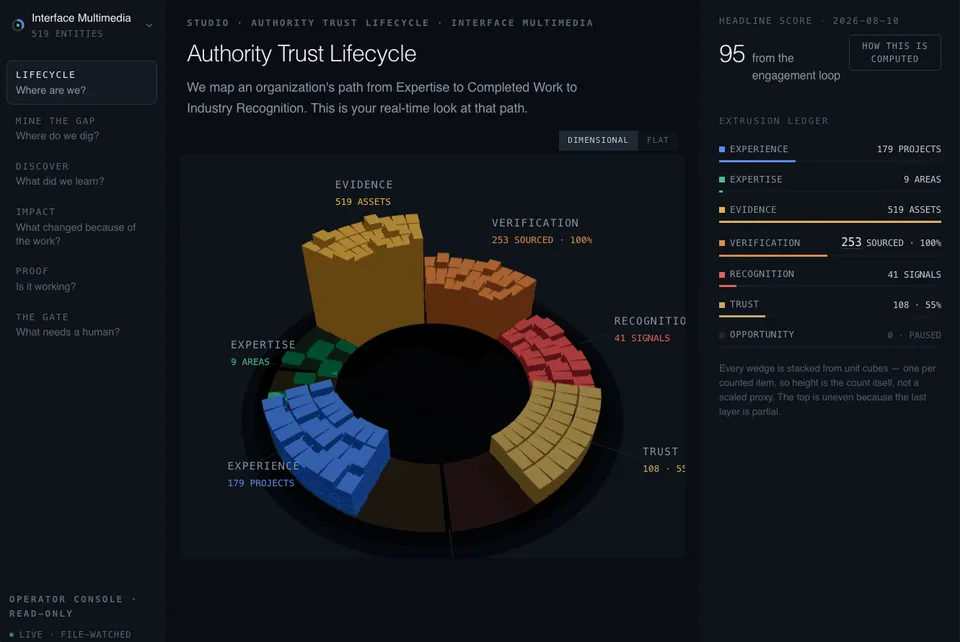
The screenshot above comes from the operator console behind our Interface Intelligence practice. The console's job is to show exactly where a firm's record runs thin. Clients see their own record in Envoy, our AI-assisted marketing platform, with each claim linked to its page on their website. When a claim comes up thin, we name the reason and put the fix on that page.
An AI answer has to be checked more than once, because it regenerates every time someone asks and shifts with the wording, the session and the assistant. That cuts both ways. A paper trail can change faster than a reputation ever could, but a single check tells you almost nothing. So we ask the same assistants the same questions on a set schedule, which is how we measured the design firm in both regions. The wording also has to be the prospect's, not the firm's. Ask about "commercial" design for a firm whose clients are developers, and the engines hear "office" and name office designers.
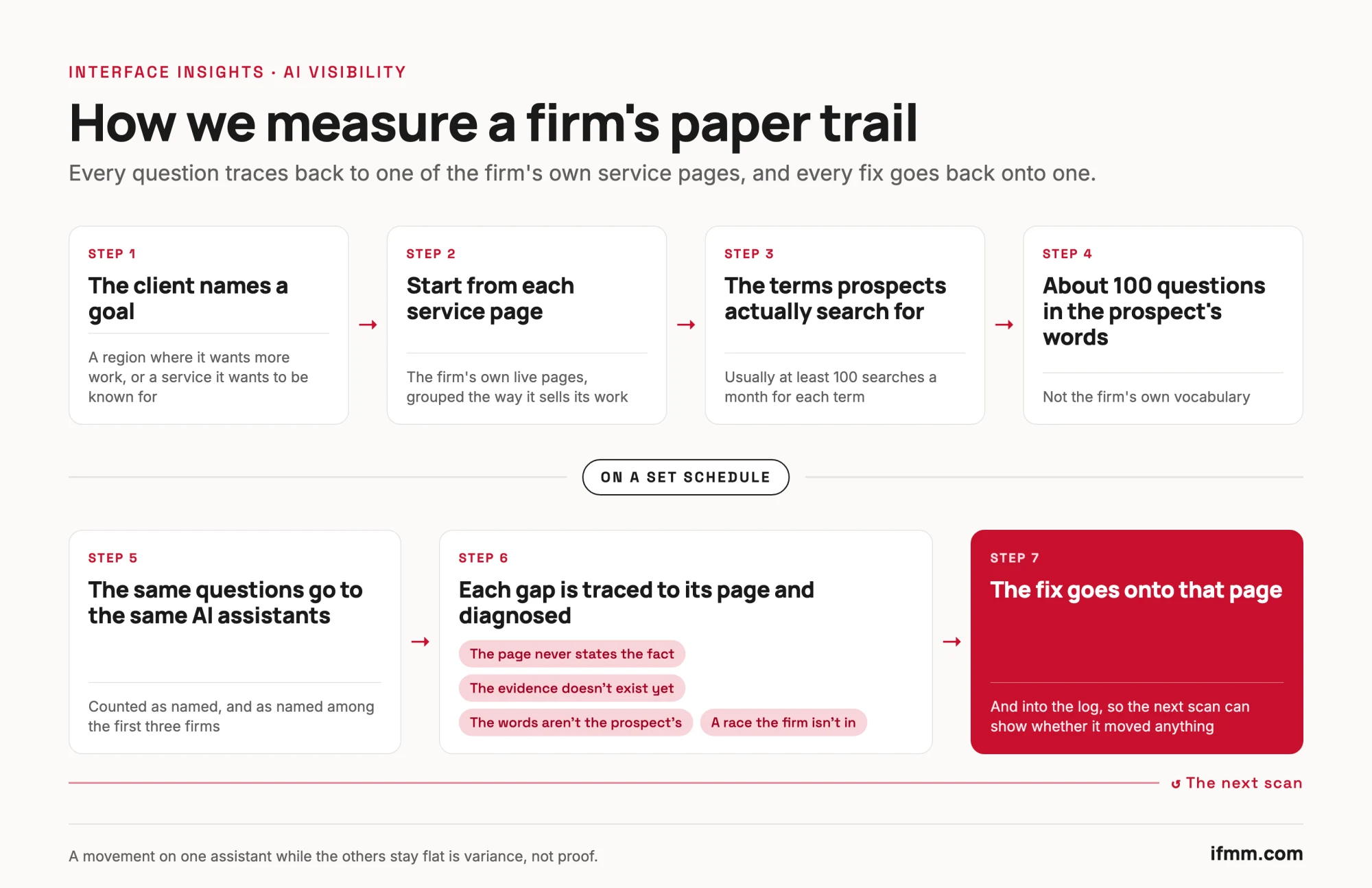
That's the measurement we built for AEC and CRE clients. Scan after scan you see exactly what the engines currently find about your firm and what's still missing. What we hand you is evidence, checked on a schedule.
Sources
- Louise Linehan, Ahrefs, Top Brand Visibility Factors in ChatGPT, AI Mode, and AI Overviews (75k Brands Studied), December 12, 2025.
- Google Search Central, AI features and your website.