

Intelligent Digital Asset Management
A digital asset platform that reads, watches, and listens to everything in the library—so thirty years of produced work is one search away. Built entirely in-house, with every AI model running on our own hardware.
Interface has engineered digital asset management systems for more than two decades—production platforms that organized and served millions of assets. Our latest platform builds on that legacy, rethought from the ground up for today's AI-equipped environment: instead of asking people to file and tag their work, it indexes storage in place, then enriches every asset automatically—captions and tags for images, text pulled from documents and scans, full transcripts for video and audio. The result is a library that answers questions: type what you remember, or what the image looks like, and the right asset surfaces in under a tenth of a second.
How it worksSearch that understands the library
Every query runs across five planes at once—keywords, filenames, folder paths, semantic meaning, and visual similarity—and the results are fused into a single ranked grid. Search for "exterior" and the platform returns assets whose pixels look like building exteriors, not just files that happen to say so in the name. Facets for type, client, and date narrow thousands of hits to the right dozen in two clicks.
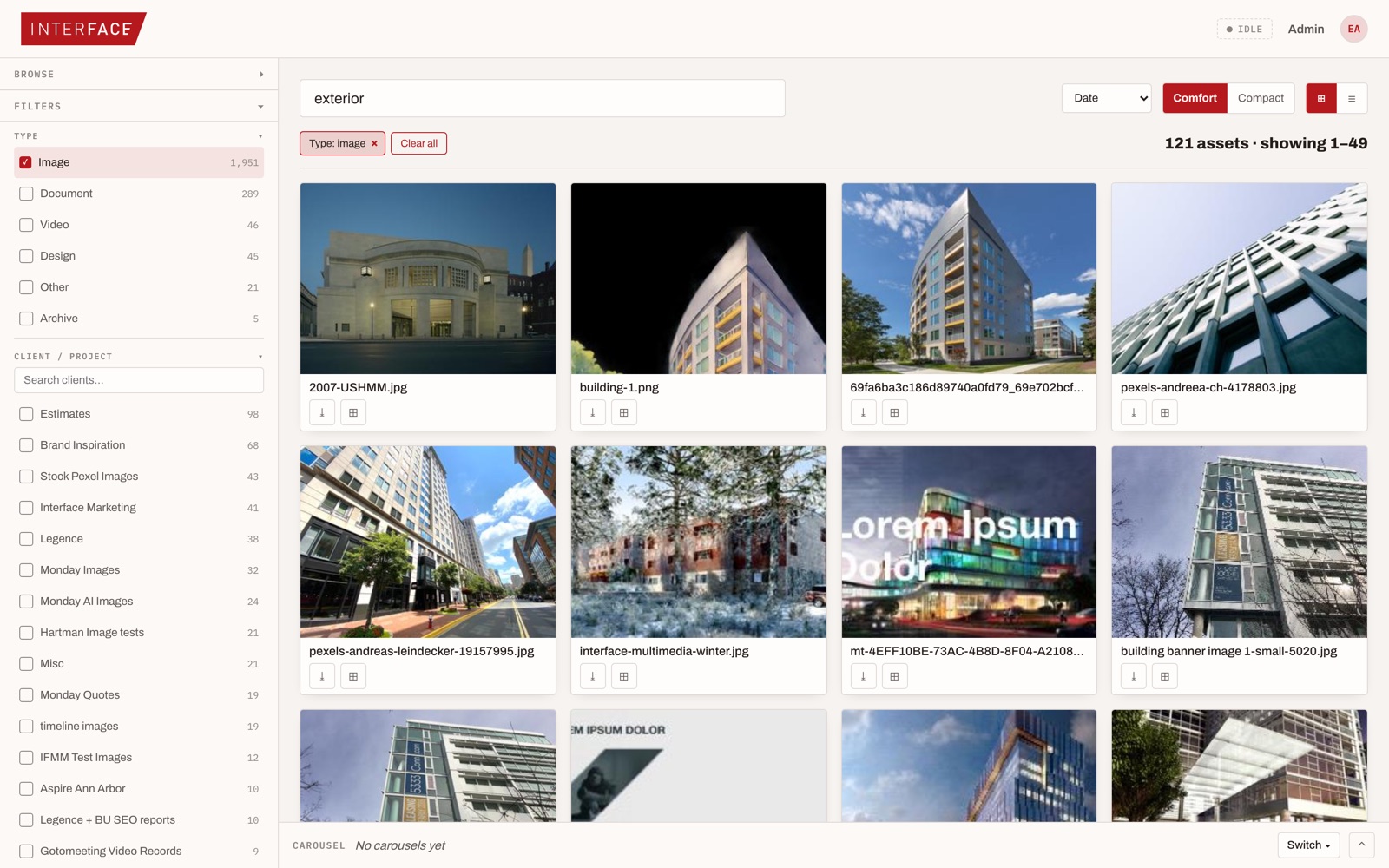
AI enrichment, entirely in-house
Every ingested asset is read by a stack of local AI models: vision models write captions and tags, OCR lifts text out of scans and screenshots, and speech recognition transcribes video and audio at 22× real time—so a spoken phrase in an hour-long recording becomes a search hit. All of it runs on Interface hardware. Nothing is sent to a cloud AI service; the assets never leave the building.
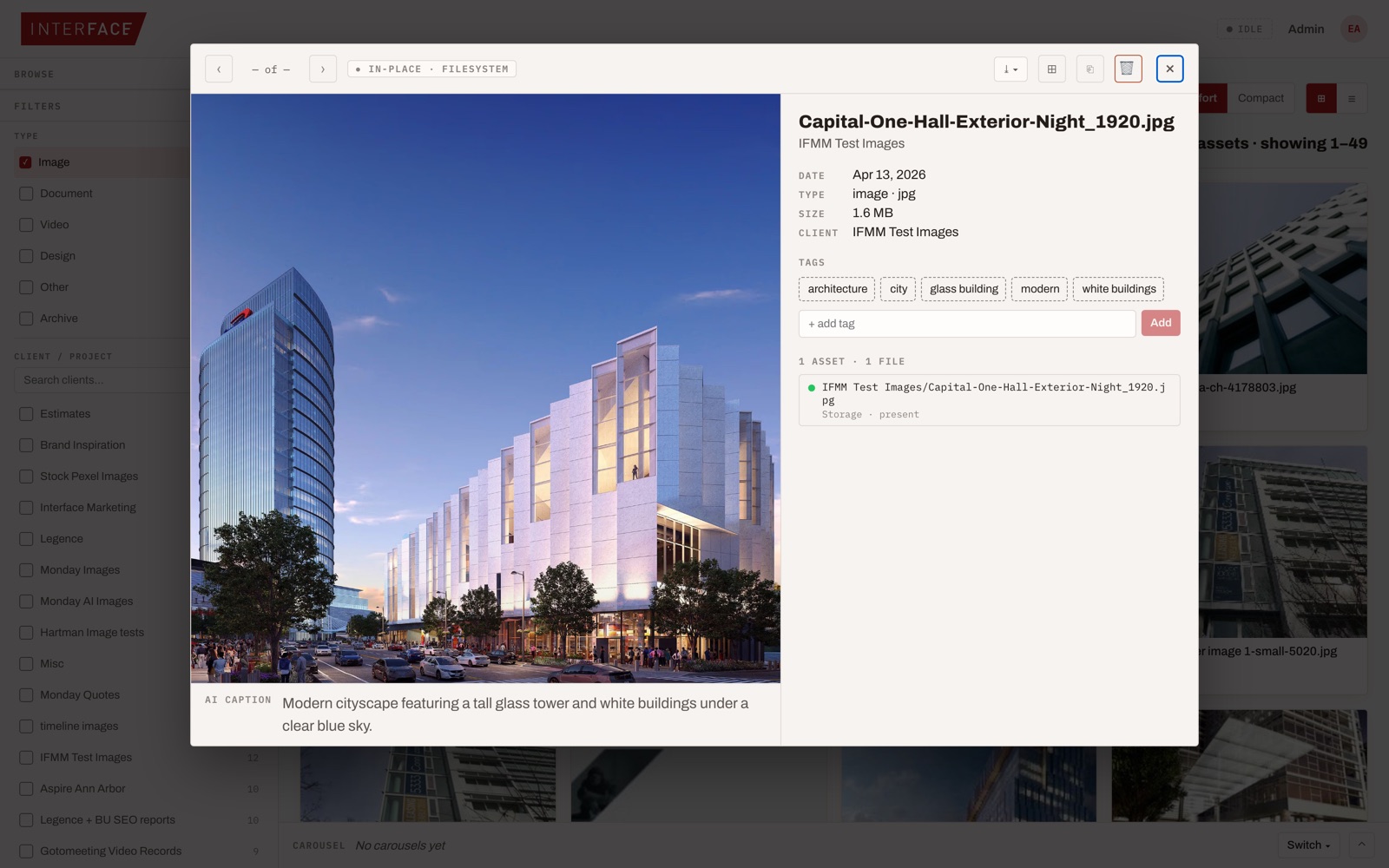
From folder to findable—automatically
There is no filing step. The platform watches the storage volumes it is pointed at: drop files into a folder and they are indexed, fingerprinted, previewed, and enriched within seconds—Photoshop and Illustrator files included. Content fingerprinting collapses duplicates scattered across drives into one asset with every known location listed, and sources are mounted read-only, so the index can never damage the originals. The browse tree is the real folder structure—no new taxonomy to invent or maintain.
Built to operate
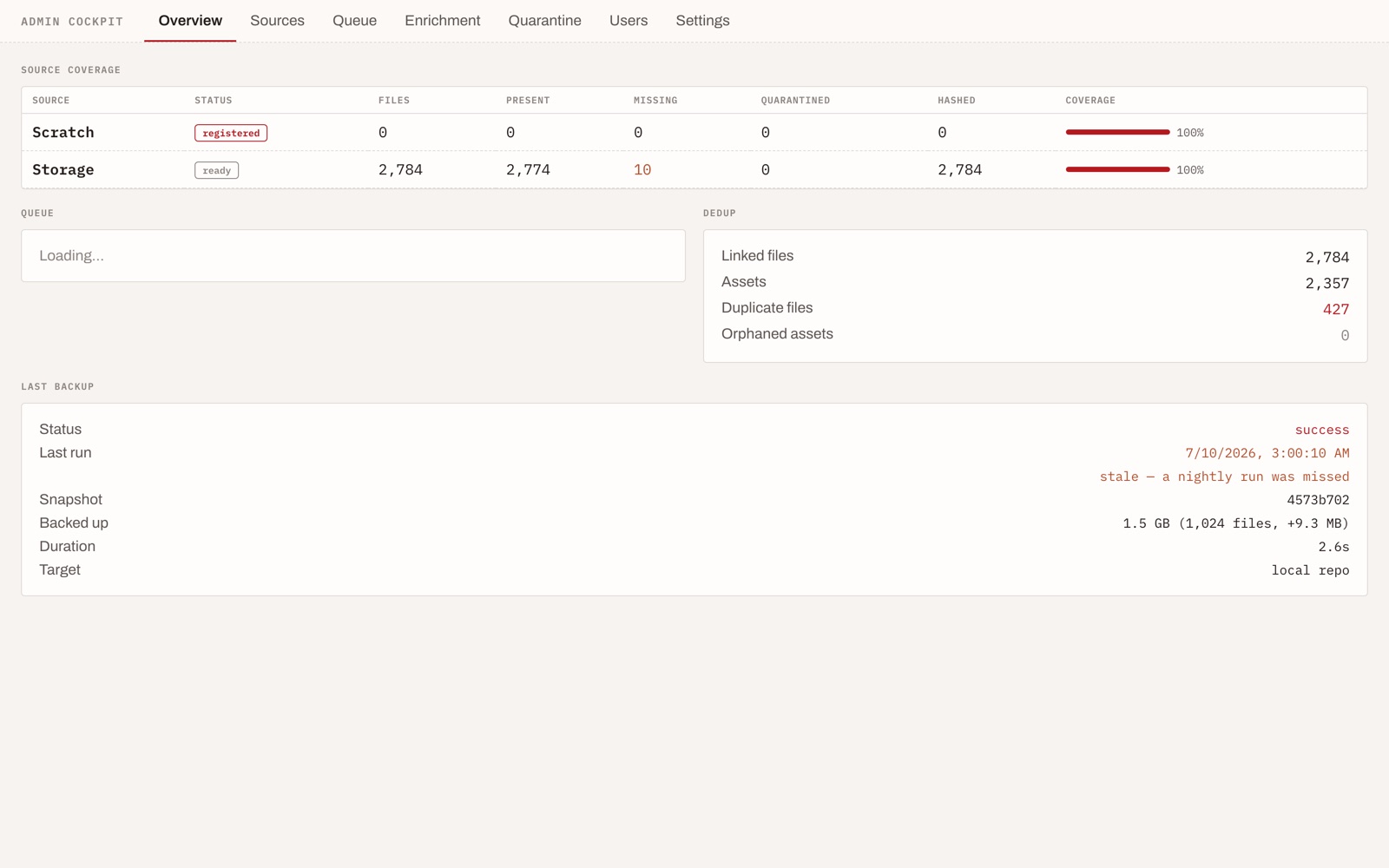
It runs as a governed production system, not a demo. Role-based permissions sit behind Google single sign-on; every file is delivered through signed, expiring URLs; and any asset can be downloaded as the untouched original or an on-demand rendition—three sizes by three formats, generated in the moment. An admin cockpit reports the whole pipeline honestly—source coverage, duplicate counts, queue depth, and whether last night's encrypted backup ran.
Every established firm sits on terabytes of produced work it can no longer find—renderings remade because the original is three drives deep, footage reshot because nobody knew it existed. This platform turns that dormant archive back into working material. Two decades of building and operating DAM systems taught us where these tools succeed and where they quietly fail—and that experience, re-engineered for an AI-equipped environment that indexes in place and keeps every model local, is what makes it fit organizations that could never send their assets to a cloud service.
Selected work
Capital One Center
A New Destination is Born
Monday Properties
Monday invests in new online digital site.
Torti Gallas + Partners
Digital Re-brand for TG+P
District Wharf
A New Waterfront EdgeWhere it earns its keep
- +Creative production archives
- +Marketing asset libraries
- +Institutional and museum collections
- +Legacy drive and server consolidation
- +Team-wide visual search
About Intelligent Digital Asset Management
What is this platform?
expand_more
Does our content get sent to a cloud AI service?
expand_more
Do we have to reorganize our files first?
expand_more
How large a library can it handle?
expand_more
Can Interface deploy this for our organization?
expand_more
Other Innovation Lab subjects
 Innovation Labarrow_forward
Real-Time Virtual Reality
Cinematic gaming engines—Unity and Unreal—rebuilt as architectural design tools. Real-time navigation, real-time material changes, headset-ready immersion before a single trade mobilizes.
 Innovation Labarrow_forward
4D Construction
A construction schedule rendered in the fourth dimension—time. Bar-chart efficiencies and conflicts surface as a 3D animation before crews mobilize.
 Innovation Labarrow_forward
360° Video & Immersive VR
End-to-end immersive experiences, built entirely in-house—from 8K aerial capture to a custom streaming platform. We fly, shoot, design, and engineer the whole pipeline, so nothing is handed off to a stock viewer.