

A general contractor who needs a certified flagging crew in DC doesn't scroll through ten blue links anymore. They open ChatGPT or Perplexity, or type the question into Google and read the answer that appears above the results. And the machine doesn't hand back a page of options. It names two or three companies and moves on.
That's the shift underneath everything here. Buyers stopped searching and started asking. When they ask, AI engines cite a small set of trusted sources, and either your firm is in that set or it isn't. There's no page two in an answer. There's the answer, and there's everyone it left out.
This is what people mean by AEO: answer engine optimization, the practice of shaping your site so an AI engine can find you, trust you, and quote you when a buyer asks a question in your field. It's a close cousin of the SEO work firms have done for years, but the target moved: you're no longer only trying to rank a page, you're trying to become the source the machine reaches for. Regional service firms (the contractors, mechanical shops, and specialty builders that make up much of the AEC world) tend to read this as a threat. What follows is the case that it's an opening.
Why Regional Firms Hold the Advantage
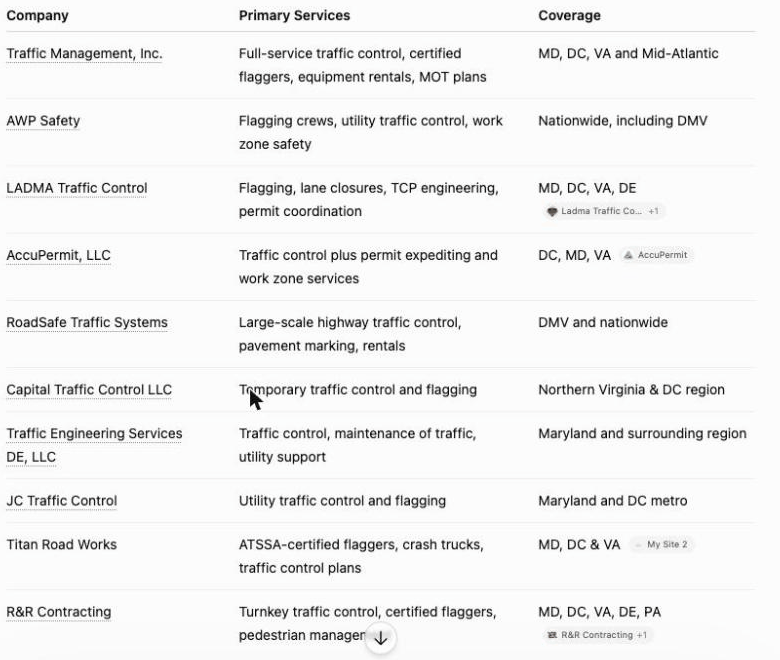
The instinct is to assume the national players win here the way they win everywhere else: the budgets, the domain authority, the decades of backlinks. Try to out-rank "traffic control company" as a regional firm and you'll lose. That term is a national head term, and it's owned.
The part that gets missed: that term is also irrelevant. A buyer's question always carries geography. Nobody with a job to fill asks for "a traffic control company" in the abstract. They ask for "ATSSA-certified flaggers in DC," or "a DBE flagging company near Baltimore." The geography isn't a modifier on the question—it is the question. And a geo-qualified question gets a geo-qualified answer, drawn from geo-qualified sources. That's the moat a national brand can't cross: it can dominate the generic term and still never surface for the specific one that actually precedes a purchase. Being the definitive regional answer is a position the big players structurally can't take from you, because the thing that makes them big makes them generic.
There's a second, sharper reason to pay attention now, and it comes from our own testing. When we measured a regional contractor's visibility against a closed AI model (one answering only from its frozen training data, with no live web access), the score came back at zero. Not low. Zero. The model simply had no idea the firm existed, because regional companies don't live in the general-knowledge data these models were trained on. Turn the web search back on and the same firm started earning citations. Our own studio saw the identical pattern: invisible to a closed model, but consistently surfaced, and in several cases ranked first, once the AI was reading the live web.
That's the lesson that makes this whole thing winnable. The battle happens in the live web index the AI reads at the moment it answers, not inside the model's memory, where a small firm can never out-weigh a Wikipedia-scale brand. And that index responds to content and structure, not to ad spend. A regional firm with a well-built site can win a fight it would lose on budget alone.
The Method: Four Steps to Getting Cited
Getting into the answer is a measurable practice, not luck and not a one-time content push. Here's how we run it.
Step one: ask the machine what it says about you today. Before changing anything, we establish a baseline. We build a set of prompts from the real questions a firm's buyers ask, geo-qualified and filtered to keep only queries with meaningful search demand behind them (we set the floor at 100 monthly searches, so we're never optimizing for phantom questions nobody asks). Then we run those prompts against web-search-enabled AI and score the result: the percentage of prompts where the firm gets cited. For R&R Contracting, that opening baseline was a score of 26 across 34 buyer questions: cited in 9 of them, absent from 25. That score is a starting line, and a map of exactly which questions to go win.
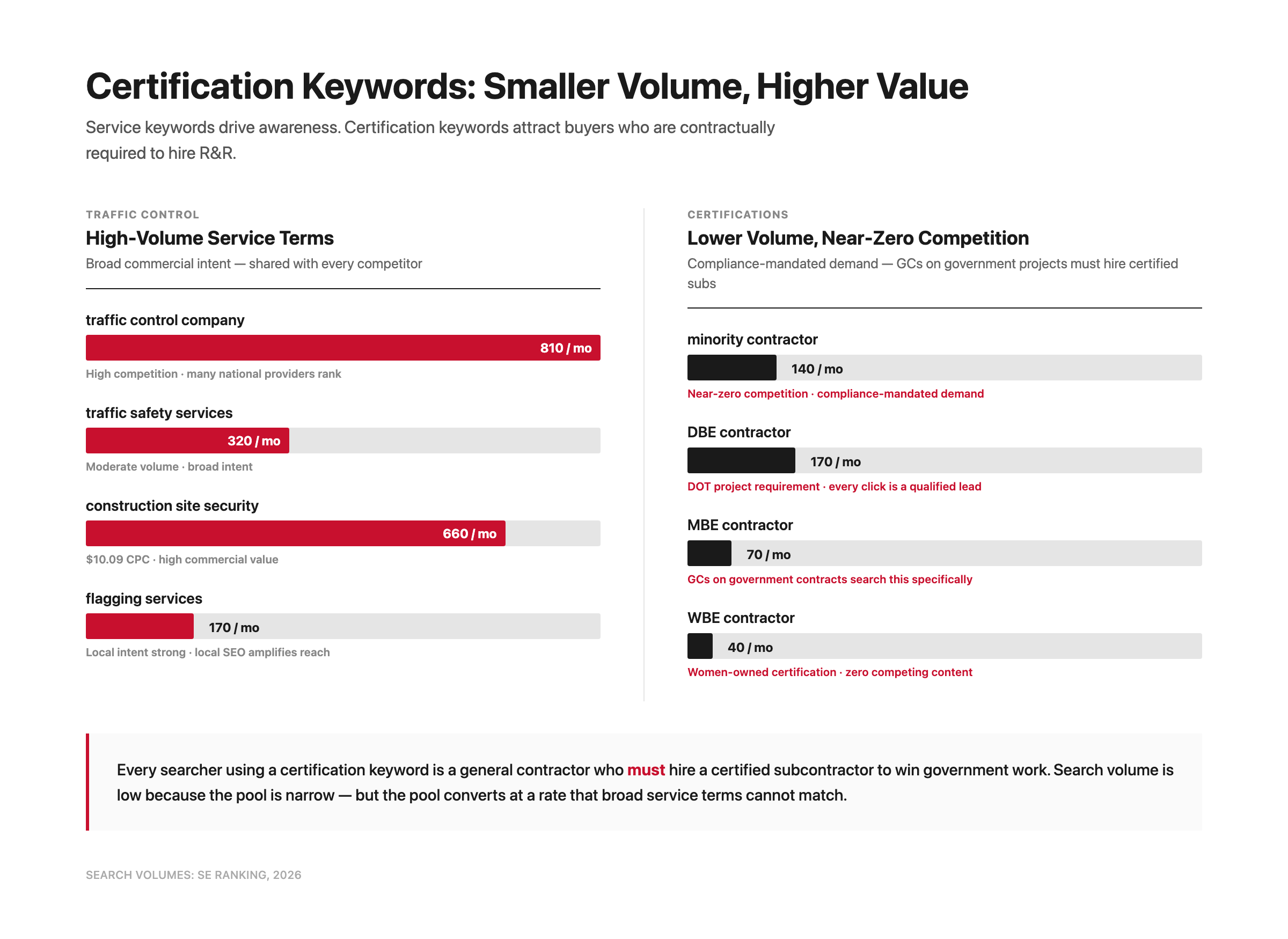
Step two: score keywords by citation value, not just volume. This is where the regional playbook diverges hardest from the old SEO habit of chasing the biggest numbers. We build out the full keyword universe (for R&R, roughly 380 terms) and rank each one not just by how many people search it, but by intent, current position, and how likely it is to trigger an AI citation. The R&R case makes the point cleanly. The firm's certification keywords (MBE, WBE, DBE, the alphabet of minority- and disadvantaged-business credentials) rank Tier 3 by search volume. Almost nobody types them. But they rank Tier 1 by conversion, because a general contractor searching "DBE subcontractor Maryland" is doing so under a government-contract requirement to hire a certified sub. The demand is mandatory, the competition is near zero, and every one of those low-volume clicks is a qualified lead. "Low volume" is exactly where a regional firm should plant its flag.
Step three: build pages a machine can quote. An AI
engine won't cite a page it can't cleanly read, so the build work is
structural: citable answer blocks that state an answer in a form the
model can lift, FAQ and organization schema that spell out who and where
the firm is in a language machines parse, an llms.txt file
and crawler permissions that explicitly invite AI systems to read the
site, and a page architecture that matches how the firm actually sells.
That last point matters more than it sounds. R&R runs two businesses
on one site: a turnkey traffic-control operation where the firm
is the service provider, and a workforce-staffing operation
where the firm supplies the crews to someone else. Those need
opposite keyword strategies. The traffic pages should claim the service
term outright, while the staffing pages must avoid it, because a buyer
searching "water main repair" wants a company to do the work, not one to
lend them labor. Built as one undifferentiated site, it confuses both
the buyer and the machine.
Step four: measure every month, not once. AI visibility is a metric you manage the way you already manage rankings, not a project you finish. We re-run the prompt set on a schedule and feed the results into a live dashboard, so the score is something a firm watches move rather than a number it heard once. Answers shift as the web shifts; the only way to know you're still in them is to keep asking.
What Happened When We Ran It
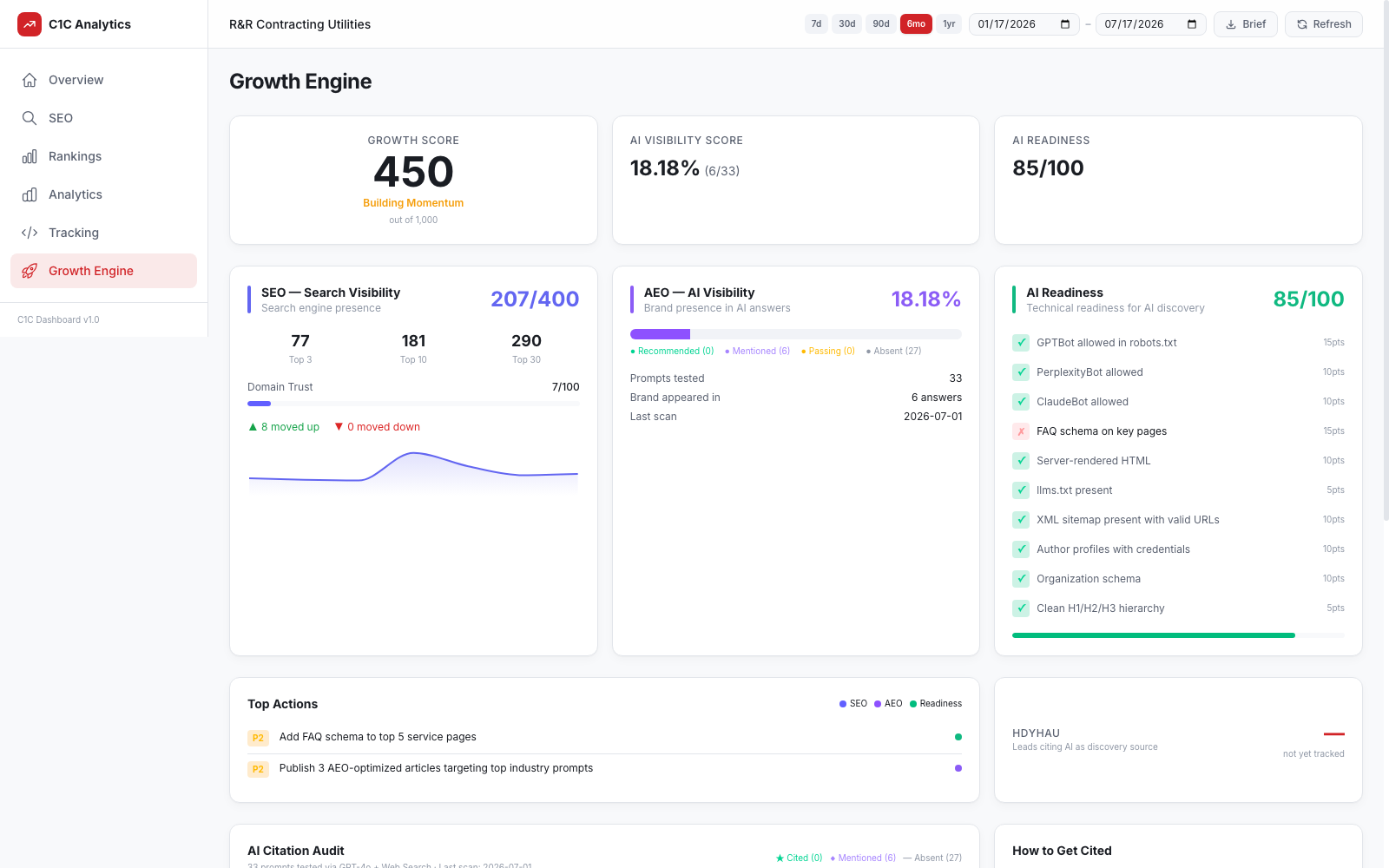
R&R Contracting launched on a brand-new domain, the hardest possible starting position, with almost no accumulated trust for an AI engine to lean on. Within weeks of the build, the firm was being cited in 9 of the 34 buyer questions we tracked, on a domain that had been invisible days earlier. The number moves scan to scan (AI answers are volatile, which is exactly why the audit runs monthly instead of once), but the citations are real: as of this writing, ask ChatGPT who provides flagging services in the DC, Maryland, and Virginia area and R&R Contracting appears in its provider table, cited from its own site. For a regional contractor starting from zero, showing up in the answer at all is the milestone that matters. And the certification pages, the low-volume, high-intent terms most firms ignore, are doing a disproportionate share of the work.
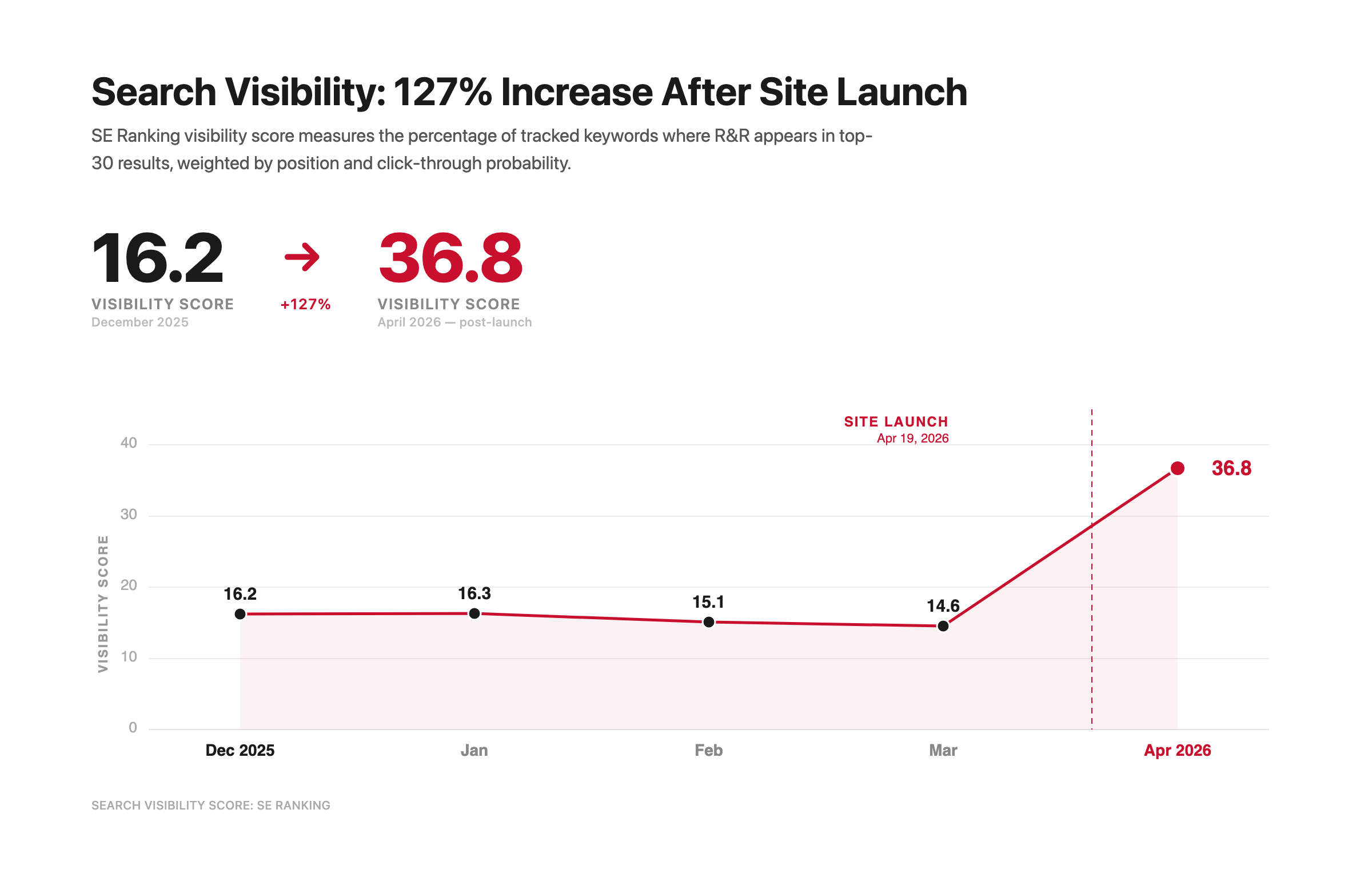
The pattern holds across a portfolio of building-systems contractors we run the same play for. On Varcomac, a DC-metro electrical contractor, baseline search optimization moved the average ranking position from 21.8 to 15.8 over 90 days: off page three and onto the front edge of where buyers actually look. On Gilbert Mechanical, a Twin Cities mechanical contractor, the same foundational work grew search clicks by 36%.
And there's an early signal in the analytics that makes the whole argument concrete: ChatGPT referral sessions are now showing up in these firms' traffic. Buyers are literally arriving from an AI answer: a machine named the firm and handed over the click, with no scrolling through results involved. That channel didn't exist a couple of years ago. It exists now, and for regional firms doing this work, it's already sending people.
What This Means for Your Firm
You can diagnose your own standing in about ten minutes, with three questions.
Does AI mention you today? Ask it. Open ChatGPT or Perplexity, type the geo-qualified question your best buyer would ask ("best commercial mechanical contractor in [your city]," "certified [your specialty] near [your metro]") and read the answer. If your firm isn't named, you have your baseline, and it's the same place R&R started.
Do your pages answer the question a buyer actually asks? Not the generic head term: the specific, geo-qualified, intent-loaded one. If your site talks about your services in the abstract but never plainly answers "who does this, and where," a machine has nothing clean to quote.
Is anyone measuring it monthly? A one-time check is a snapshot of a moving target. If no one tracks your AI visibility on a schedule, you don't know whether you're in the answer this month, only that you were, once.
If those three questions surface a gap, that gap is the opportunity. The firms that get cited over the next two years will be the ones who understood, early, that the answer is a shelf with room for only a few names, and did the work to earn a place on it. Budget has surprisingly little to do with it. That's the work our data and growth practice does. If you want to know where your firm stands, ask the machine, then let's talk about what it said.